
Continuing education is often grouped with online courses.
In practice, they solve different problems.
Most learning management systems are built around content delivery.
Continuing education programmes are built around proof – proof of learning, proof of compliance, and proof that requirements have been met consistently over time. That difference affects how credits are tracked, how certificates are issued, and how learner records need to be stored.
This guide is written for organizations that deliver structured continuing education rather than one-off training. That includes professional associations, accredited training providers, universities offering CE or Continuing Professional Development (CPD) programmes, licensing bodies, and educators responsible for regulated professional development.
If your learners need to earn credits, renew certifications, or demonstrate compliance to an external body, the LMS you choose will either simplify that work or quietly complicate it.
We’ve seen organisations underestimate this early on, only to discover later that their LMS was never designed to support the obligations that come with continuing education.
The purpose of this guide is to identify learning management systems that are genuinely suited to continuing education delivery, based on how they perform in real operational scenarios, not how they present themselves in marketing material. It is written for organisations actively comparing the best LMS platforms for continuing education, rather than generic course platforms repurposed for CE.
This perspective reflects a broader shift we’ve seen across professional education. In a recent discussion between Chris Badgett and Kurt von Ahnen on continuing education and professional learning models, they highlight how CE programmes operate under fundamentally different constraints from traditional courses, particularly around credits, compliance, and long-term learner records.
The Best LMS Platforms for Continuing Education in 2026 – At a Glance
Based on our evaluation criteria, the platforms below stand out for organisations delivering continuing education in 2026. Each supports CE requirements in different ways, depending on scale, structure, and compliance needs.
This guide covers:
- LifterLMS
- Moodle Workplace and Moodle LMS
- Canvas
- Blackboard
- TalentLMS
- Absorb LMS
- Docebo
What Continuing Education Actually Requires From an LMS
Continuing education is not a feature toggle. It is an operating model that places different demands on an LMS from the outset.
At the centre of most CE programmes is credit management. Unlike standard courses, completion alone is rarely sufficient. Credits may be calculated by time, points, activity type, or combinations of all three. In some cases, partial credit must be awarded.
A suitable LMS must calculate credits accurately, retain them over time, and present them clearly to learners and administrators without manual reconciliation.
We’ve found that manual credit tracking often starts as a temporary workaround and quietly becomes permanent, even as programmes grow more complex.
Certificates introduce a second layer of complexity. In continuing education, certificates function as evidence. They often include expiry dates, renewal conditions, and references to specific accrediting bodies or standards. An LMS that treats certificates as static files rather than managed credentials increases both administrative effort and compliance risk.
We’ve seen renewal logic and certificate expiry become urgent issues years after launch, when learners return expecting records that the platform can no longer surface cleanly.
Beyond credits and certificates sits compliance. Many CE programmes must withstand audit or external review. That requires detailed learner records, time-stamped completion data, and the ability to generate accurate reports on demand. Platforms with shallow reporting or fragmented data exports tend to struggle under scrutiny.
In practice, these gaps usually surface during audits or external reviews, when questions need to be answered quickly, and data must be defensible.
Delivery format adds another layer of pressure. Continuing education rarely follows a single pattern. Programmes may combine self-paced learning, live sessions, recorded content, or structured pathways that bundle multiple activities into a single credit outcome. An LMS must support this flexibility without forcing content duplication or fragile configurations.
Taken together, a continuing education LMS must reliably support:
- Credit calculation and accumulation across multiple activities
- Certificate issuance, expiry, and renewal
- Compliance-ready reporting and long-term record retention
- Flexible delivery models
- Clear visibility for learners and administrators
Finally, continuing education does not operate in isolation. Most organisations depend on other systems to run their programmes effectively.
These commonly include:
- Membership or association management systems
- CRMs and learner databases
- Payment and billing platforms
- Identity or access management tools
An LMS that cannot integrate or extend cleanly often becomes a bottleneck elsewhere in the organisation.

Continuing Education LMS Requirements Checklist
If you are evaluating LMS platforms for continuing education, the checklist below can be used as a practical reference during demos or internal reviews.
A CE-ready LMS should be able to:
- Track credits across multiple courses and activities
- Support partial credit where applicable
- Issue certificates with expiry dates and renewal logic
- Retain historical learner records for audit purposes
- Produce exportable compliance reports on demand
- Support multiple delivery formats without duplication
- Integrate with membership, CRM, or payment systems
How We Evaluated LMS Platforms for Continuing Education
This guide evaluates LMS platforms specifically through the lens of continuing education delivery, not general online learning.
Each platform was assessed against the same criteria to ensure a consistent and meaningful comparison, based on the kinds of CE requirements we see organisations raise during real evaluations.
No single factor determined the ranking. Instead, platforms were evaluated on how well they support real continuing education workflows across credit tracking, certificates, compliance, administration, and integration needs.
Flexibility was treated as a core requirement. Continuing education programmes vary widely across industries, and platforms that assume a single delivery or credit model tend to break down quickly. Systems that let administrators configure rules without custom development scored more highly.
Administration effort was evaluated with scale in mind. Managing a small cohort is very different from overseeing thousands of learners with ongoing credit obligations. We considered how easy it is to maintain accurate records, generate reports, and support learners over time.
Learner experience was assessed primarily for clarity rather than visual polish. CE learners need to understand what they have earned, what is still outstanding, and how to access certificates or transcripts without confusion.
We also examined integrations and ecosystem support, recognising that no LMS operates alone in a continuing education environment. Platforms with strong native integrations, extensibility, or well-documented APIs were favoured over closed systems.
Finally, we considered cost structure and scalability. Continuing education programmes often grow gradually, and pricing models that become unpredictable or punitive as usage increases can undermine long-term viability.
In short, platforms were evaluated based on their ability to support continuing education as an ongoing obligation rather than a one-time transaction. This approach reflects how organisations typically assess the best LMS platforms for continuing education when long-term compliance, reporting, and learner records are at stake.
This guide is written by the team behind LifterLMS. All platforms were evaluated using the same criteria, and tradeoffs are stated explicitly, including where other platforms may be a better fit.
Who the Customer is Matters More Than Most LMS Feature Lists
In continuing education, the learner is not always the buyer. In many cases, access is purchased by an employer, a professional body, or a licensing organisation on behalf of learners. This distinction has practical implications for LMS selection.
When organisations are buying seats in bulk, managing cohorts, or overseeing compliance across teams, the LMS must support group enrolment, delegated administration, and consolidated reporting. These requirements are often absent from platforms designed primarily for direct-to-consumer course sales.
In practice, this means evaluating whether an LMS can support:
- Group-based enrolment and access control
- Admin or manager views for tracking learner progress
- Reporting across organisations, departments, or cohorts
Platforms that handle these workflows well tend to perform better in continuing education contexts where learning is funded, monitored, or mandated by a third party.
For example, in WordPress-based CE setups, tools like LifterLMS Groups are often used to manage organisational enrolments, assign group managers, and report on learner progress at scale. This kind of structure is particularly relevant for employers purchasing training in bulk or associations overseeing member compliance.
Common Continuing Education Delivery Models
Continuing education programmes tend to look similar on the surface, but the underlying delivery models vary more than most LMS comparison articles acknowledge. Understanding which model you are running, or plan to run, is essential before evaluating platforms.
The simplest model is fully self-paced learning. Learners complete courses independently, earn credits based on defined rules, and receive certificates once requirements are met. This approach scales well, but places heavy emphasis on accurate credit calculation, clear learner dashboards, and reliable reporting.
Many organisations move beyond this into live or blended delivery. Live sessions, whether in-person or virtual, are often combined with recorded content or follow-up assessments. In these cases, the LMS must support attendance tracking, conditional credit awarding, and delayed completion logic. Platforms designed only for on-demand learning often struggle here.
More mature CE programmes use structured pathways. Learners complete multiple activities across a defined period, sometimes choosing from approved options to reach a required credit total. This model introduces complexity around prerequisites, partial credit, and progress visibility for both learners and administrators.
We’ve found that structured pathways tend to emerge as programmes mature, often replacing simpler models that worked early on but no longer scale.
For example, a professional association might require members to earn 20 credits annually, drawn from a mix of on-demand courses, live webinars, and approved external activities. An LMS supporting this model must track credits across multiple sources, clearly display progress, and retain records for audit purposes.
Across these models, most continuing education programmes fall into one of the following patterns:
- Self-paced courses with fixed credit values
- Live or blended programmes with attendance-based credit
- Credit bundles or learning pathways spanning multiple activities
An LMS that supports only one of these patterns can limit future growth.
Common Mistakes Organisations Make When Choosing an LMS for CE
Many organisations choose an LMS based on how well it delivers content, then attempt to layer continuing education requirements on top. That approach often creates friction later.
One common mistake is assuming certificates equal compliance. Generating a certificate does not guarantee that credit rules, renewal cycles, or audit requirements are being met. When certificates lack logic or lifecycle management, administrative effort increases quickly.
Another frequent issue is underestimating reporting needs. Continuing education reporting is not just about completion rates. Administrators may need to track credits over time, produce learner transcripts, or respond to external audits. Platforms that rely on manual exports or spreadsheet reconciliation create ongoing risk.
A third mistake is choosing systems that are rigid by design. Continuing education programmes evolve. Credit rules change. Delivery models expand. LMS platforms that require custom development for every adjustment slow teams down and increase long-term costs.
These problems tend to surface only after a programme is live, often when reporting requests, renewals, or audits expose gaps the platform was never designed to handle. At that point, switching platforms becomes much more difficult.
Why LMS Migration is Especially Costly for Continuing Education
Changing LMS platforms is disruptive in any learning context, but it is particularly risky for continuing education programmes. Learner records, historical credits, expired certificates, and audit trails must often be retained for years.
Platforms that do not support clean data export or long-term record access can make migration complex, expensive, or incomplete.
This is why continuing education LMS decisions tend to matter more five years in than in the first five months.
How to Evaluate an LMS Demo for Continuing Education Use Cases
LMS demos are often polished, but they rarely reflect real continuing education workflows. To evaluate platforms properly, demos need to be tested against your actual requirements.
We’ve learned that polished demos often highlight what a platform does best, while glossing over the areas that matter most once a CE programme is in motion.
Start by focusing on credit logic rather than course creation. Ask how credits are calculated, where they are stored, and how learners can view their progress. If answers are vague or rely heavily on manual processes, that is a warning sign.
Next, examine certificates and renewals. Look beyond visual design and ask how expiry dates are handled, how renewals are triggered, and whether historical certificates remain accessible. These details matter far more than branding options.
Reporting should be tested early. Ask to see how learner records are exported, how credit totals are calculated across multiple activities, and how reports would be produced for an external body. If reporting requires custom work or third-party tools, factor those costs and risks into the long-term cost and risk.
Finally, consider how the LMS fits into your wider systems. Continuing education rarely operates alone. An LMS should integrate cleanly with membership platforms, CRMs, or payment systems, or provide clear extension points to enable such integration.
When evaluating demos, it helps to centre questions around three areas:
- How credits are earned, tracked, and displayed.
- How certificates and renewals are managed over time.
- How compliance data is reported and retained.
If a platform cannot demonstrate these clearly, it is unlikely to support a serious continuing education programme.
How These Platforms Differ for Continuing Education
While all of the platforms in this guide can support continuing education in some form, they differ significantly in how they handle credits, certificates, compliance, and control.
Broadly speaking:
- Academic-first platforms prioritise structured courses and institutional reporting.
- Enterprise platforms focus on scale, automation, and certification workflows.
- Flexible platforms prioritise configurability, integration, and ownership.
Best LMS Platforms for Continuing Education – Quick Comparison
The table below provides a high-level view of how leading LMS platforms differ when used for continuing education. It focuses on overall strengths, typical use cases, and key tradeoffs, rather than exhaustive feature lists. Use it to narrow your options quickly, then refer to the individual platform sections for deeper context.
| Platform | Core CE strength | Best fit for | Main tradeoff |
|---|---|---|---|
| LifterLMS | Flexible credit tracking and credential control | Associations and providers using WordPress | Requires WordPress management |
| Moodle Workplace / LMS | Deep configurability for complex CE models | Institutions with technical resources | High setup and maintenance overhead |
| Canvas | Strong academic reporting and structure | Universities extending into CE | Limited flexibility outside academic models |
| Blackboard | Compliance and audit readiness | Large, regulated organisations | Slow to adapt and administratively heavy |
| TalentLMS | Fast setup for simple CE programmes | Small to mid-sized CE providers | Limited depth for complex CE workflows |
| Absorb LMS | Enterprise reporting and certification support | Certification-driven professional CE | Enterprise cost and configuration |
| Docebo | Automation and scalability | Large organisations with complex ecosystems | Less native fit for standalone CE |
If you are short on time, start with the platform that most closely matches your organisation type. The detailed reviews that follow explain where each option performs well and where trade-offs emerge over time.
LifterLMS
Best for: Organisations that want full control over continuing education delivery, credit tracking, and certificates within a flexible WordPress-based ecosystem.
Less suited to: Organisations that want a fully managed, vendor-hosted LMS with minimal involvement in configuration, hosting, or ongoing site management.
CE snapshot: A flexible, WordPress-based LMS that lets organisations design continuing education programmes around their own credit rules, renewal cycles, and integrations.
LifterLMS (yes, that’s us) is a WordPress-based learning management system designed to give organisations full control over how learning is structured, delivered, and extended. In a continuing education context, its strength lies in flexibility and ownership rather than rigid, pre-defined workflows.
LifterLMS is best suited to organisations that want to design continuing education programmes tailored to their own rules, branding, and systems, rather than adapting them to fit a closed platform. This includes associations, independent training providers, and institutions already operating on WordPress.
For continuing education specifically, LifterLMS supports credit-based learning through configurable course structures and extensions. The Continuing Education add-on allows organisations to track earned credits across courses and activities, creating a clearer link between learning activity and professional requirements. Credits can be accumulated over time, displayed to learners, and used as part of broader CE workflows.
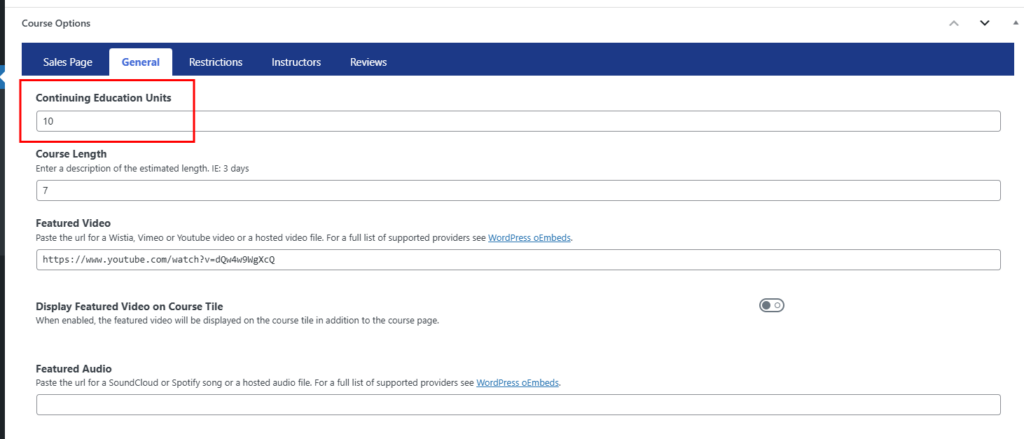
A typical use case would be tracking members’ annual CE requirements, where credits earned across multiple courses contribute to a renewal threshold and certificates expire automatically at the end of each cycle.
Click here to learn more about the Continuing Education add-on.
Certificates in LifterLMS are managed as part of a wider credential system rather than as isolated files. This makes it easier to automatically issue certificates, manage renewals, and retain historical records. For CE providers, this supports both learner clarity and audit readiness.
Reporting and record management are handled within the WordPress environment, which gives organisations direct access to learner data. This is particularly valuable for teams that need to retain records long-term or integrate learning data with other systems such as CRMs or membership platforms.
Key continuing education strengths include:
- Flexible credit tracking through the Continuing Education add-on
- Certificate management with support for renewals and historical access
- Strong integration options within the WordPress ecosystem
- Full control over data, branding, and programme structure
LifterLMS performs especially well when continuing education is part of a broader digital platform rather than a standalone system. Organisations already using WordPress can connect learning with content, membership, events, and communications without maintaining multiple disconnected tools.
There are, however, important considerations. LifterLMS assumes a level of comfort with WordPress. While this gives flexibility, it also means responsibility for hosting, updates, and site management sits with the organisation or its technical partners. Teams seeking a fully managed, hands-off LMS may prefer a closed, hosted platform.
LifterLMS is also intentionally modular. Many advanced CE capabilities are delivered through add-ons rather than bundled into a single licence. This keeps the core platform lean, but requires thoughtful configuration to match specific CE requirements.
LifterLMS is a strong fit for organisations that value control, extensibility, and ownership. It may be less suitable for teams that want a fully managed system with minimal configuration, or for programmes that require highly standardised workflows imposed by an external authority.
Pricing follows a transparent, licence-based model, with costs tied to the features you choose to enable rather than learner volume alone. This can be advantageous for CE programmes that grow steadily over time without predictable enrolment spikes.
In short, LifterLMS is not a prescriptive continuing education system. It is a flexible foundation that allows continuing education programmes to be built deliberately, with credit tracking and credentialing layered in to match real-world requirements.
Moodle Workplace and Moodle LMS
Best for: Institutions with technical resources that need highly configurable continuing education structures and are willing to manage complexity through plugins or custom development.
Less suited to: Organisations without dedicated technical resources or those seeking a low-maintenance continuing education platform out of the box.
CE snapshot: A highly configurable platform capable of supporting complex continuing education structures, provided the organisation can manage the technical overhead.
Moodle remains one of the most widely used learning platforms in education, and its flexibility makes it a common choice for continuing education programmes, particularly in academic and institutional settings.
Moodle is best suited to organisations with internal technical capacity or access to experienced Moodle partners. Its open-source foundation allows extensive customisation, but that flexibility comes with operational complexity.
For continuing education, Moodle’s strength lies in its ability to model complex learning structures. Credit tracking and completion rules can be configured to support a wide range of CE scenarios, including blended learning and long-term programmes. Certificates and reporting can be extended through plugins or custom development.
Key continuing education strengths include:
- Highly configurable learning structures and completion rules
- Strong reporting options when properly configured
- Large ecosystem of plugins and integrations
Limitations to consider are equally important. Moodle does not offer a consistent out-of-the-box CE experience. Many CE-critical features depend on third-party plugins or custom builds, which increases setup time and long-term maintenance effort.
From a pricing perspective, Moodle software itself is free, but the total cost depends heavily on hosting, development, support, and ongoing administration. For organisations with the right resources, it can be powerful. For smaller teams, it can become burdensome.
Canvas
Best for: Universities delivering continuing education alongside degree programmes where CE closely mirrors traditional academic course structures.
Less suited to: Continuing education programmes that require flexible credit logic or delivery models outside traditional academic structures.
CE snapshot: An academic-first LMS that supports continuing education best when CE offerings closely resemble traditional university course models.
Canvas is widely adopted in higher education and is often associated with formal academic programmes rather than standalone continuing education. That heritage shapes both its strengths and its limitations.
Canvas works well for institutions that already operate within structured academic frameworks and want to extend into continuing education without introducing a separate platform. Its core strengths lie in course delivery, grading, and integration with academic systems.
For CE use cases, Canvas can support credit-based learning and structured programmes, particularly when CE offerings mirror traditional course formats. Reporting and learner records are robust within the academic model.
However, Canvas is less flexible when CE programmes deviate from semester-based structures or require custom credit logic. Certificate management and renewal workflows often require additional tooling or manual processes.
Canvas is best for:
- Universities offering CE alongside degree programmes
- Institutions prioritising consistency over flexibility
- Teams with existing Canvas expertise
Pricing is enterprise-level and typically tied to institutional agreements. Canvas excels in academic environments, but may feel restrictive for independent CE providers or associations with evolving delivery models.
Blackboard
Best for: Large, regulated organisations that prioritise compliance, reporting, and stability over flexibility or rapid programme changes.
Less suited to: Organisations that need agility, frequent programme changes, or lower administrative overhead in their continuing education delivery.
CE snapshot: A compliance-oriented platform designed for stable, regulated continuing education environments where reporting and audit readiness are priorities.
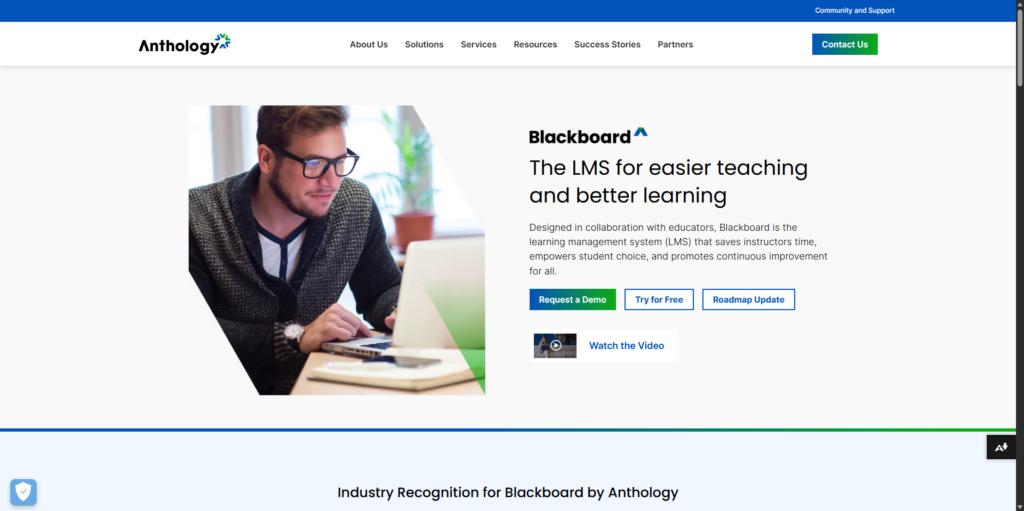
Blackboard has long been associated with large institutions and regulated learning environments. Its focus on compliance, reporting, and structured delivery makes it a familiar option in certain continuing education contexts.
Blackboard supports detailed learner records and reporting, which aligns well with audit-driven CE programmes. For organisations operating under strict regulatory oversight, this can be a significant advantage.
That said, Blackboard’s complexity can be a drawback. Configuration and administration often require specialised knowledge, and adapting the platform to non-traditional CE models can be slow.
Continuing education strengths include:
- Strong compliance and reporting capabilities
- Detailed learner record management
- Familiarity within regulated institutions
Limitations include higher administrative overhead and limited agility. Blackboard is rarely the fastest platform to adapt when CE programmes change or expand.
Pricing and contracts are typically enterprise-focused. Blackboard suits large organisations with stable requirements more than agile CE providers experimenting with new formats.
TalentLMS
Best for: Smaller CE providers running straightforward credit-based programmes who value speed of setup and ease of use over advanced compliance workflows.
Less suited to: Organisations with complex credit rules, renewal cycles, or audit-heavy compliance requirements.
CE snapshot: A lightweight LMS suited to straightforward continuing education programmes with simple credit and certificate requirements.
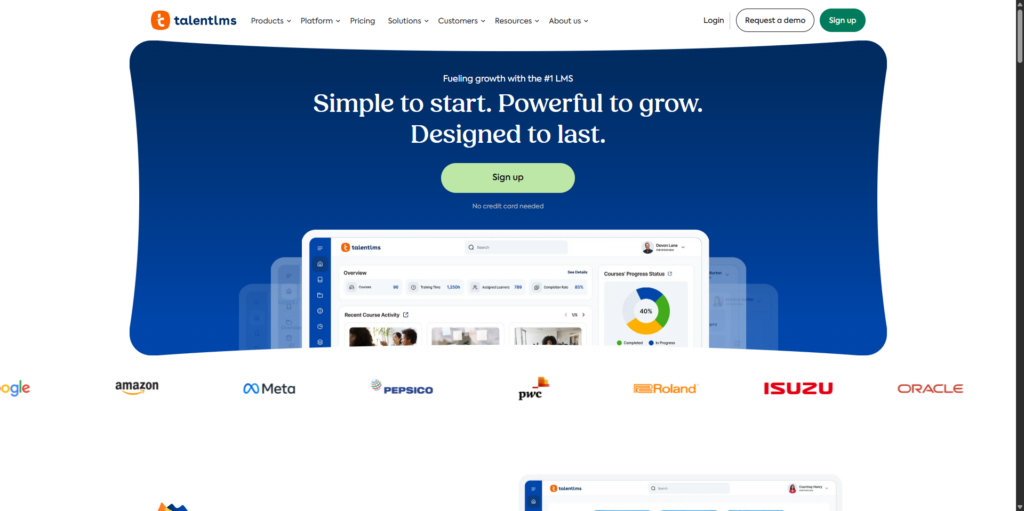
TalentLMS is often positioned as a lightweight, easy-to-use platform for training and professional development. It appeals to organisations that want to move quickly without heavy technical investment.
For continuing education, TalentLMS performs best in simpler scenarios. It supports basic credit attribution through course completion and offers certificate generation suitable for straightforward CE programmes.
Its strengths lie in usability and setup speed. Administrators can launch programmes quickly, and learners generally find the interface intuitive.
However, TalentLMS shows limitations as CE requirements grow more complex. Advanced credit logic, renewal cycles, and audit-grade reporting are less well developed than on enterprise- or education-focused platforms.
TalentLMS is a reasonable fit for:
- Small to mid-sized CE providers
- Programmes with simple credit rules
- Teams prioritising ease of use over depth
Pricing is transparent and accessible, but organisations planning long-term or highly regulated CE programmes may outgrow the platform.
Absorb LMS
Best for: Professional organisations delivering certification-driven continuing education at scale with strong reporting and compliance requirements.
Less suited to: Smaller CE providers or organisations that need deep customisation beyond enterprise-oriented certification workflows.
CE snapshot: An enterprise LMS built to support large-scale, certification-driven continuing education with strong reporting and learner management.
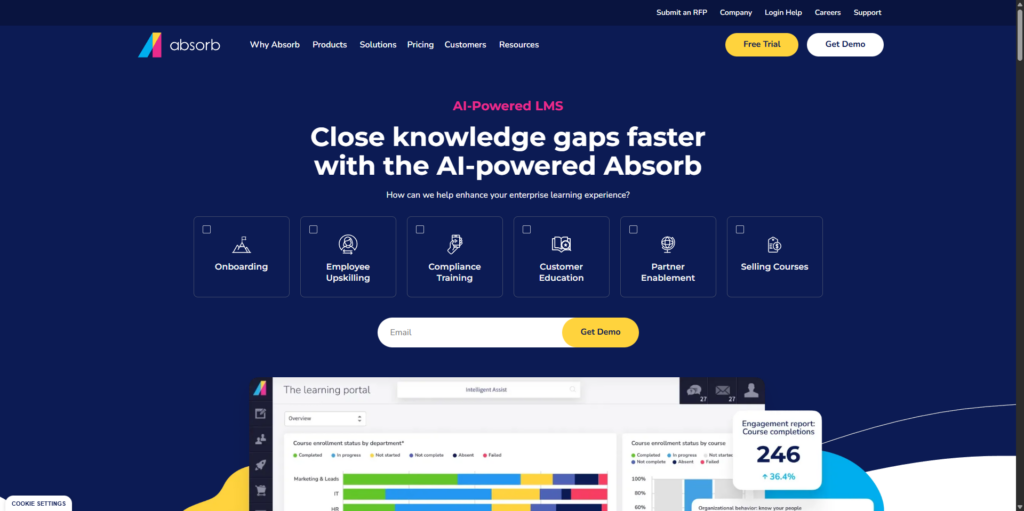
Absorb LMS positions itself as a modern, enterprise-ready learning platform with strong reporting and automation features. It is commonly used in corporate training and professional certification contexts.
For continuing education, Absorb offers solid support for credit tracking, reporting, and learner management. Its reporting tools are more advanced than many mid-market platforms, which benefits organisations with compliance requirements.
Absorb performs well when CE programmes resemble professional certification or workforce development models. It supports structured programmes and can scale across large learner populations.
It works well at scale, but it’s less comfortable when you need to bend the platform to fit more specialised or unusual CE workflows. Custom or association-specific CE workflows often require extra configuration and can add cost.
Absorb is best suited to:
- Large professional organisations
- Certification-driven CE programmes
- Teams with reporting and compliance priorities
Pricing reflects its enterprise focus and may be less accessible for smaller providers or early-stage CE initiatives.
Docebo
Best for: Large organisations embedding continuing education within broader training ecosystems that require automation, scale, and enterprise-grade administration.
Less suited to: Standalone continuing education programmes that do not require enterprise-scale automation or corporate learning infrastructure.
CE snapshot: A scalable, automation-focused platform that works best when continuing education is part of a broader corporate or partner learning ecosystem.
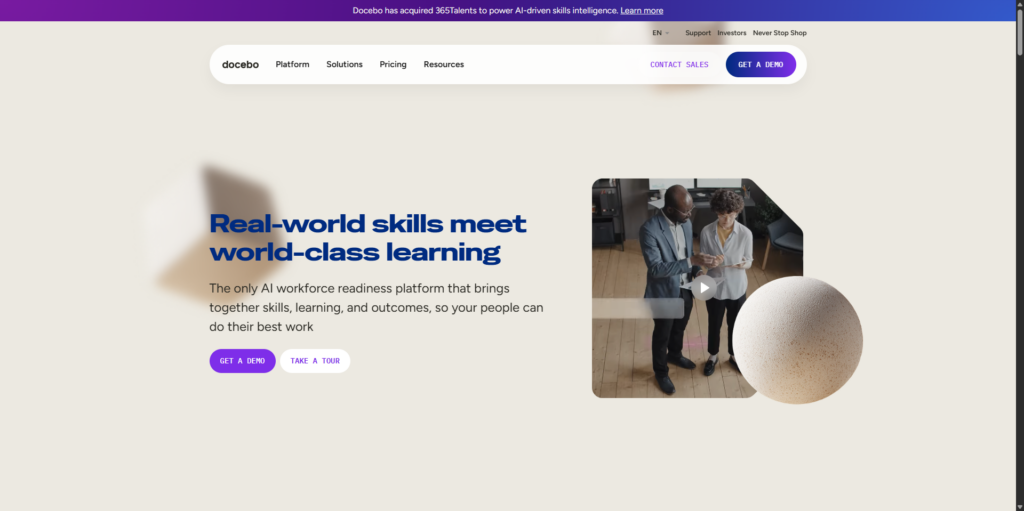
Docebo is a feature-rich platform designed for large-scale learning programmes, often in corporate or partner education environments. Its automation and AI-driven features differentiate it from more traditional LMS platforms.
In a continuing education context, Docebo can support structured programmes with complex reporting needs. Its scalability and automation tools are strengths for organisations managing large, distributed learner bases.
That said, Docebo’s CE suitability depends heavily on how closely CE workflows align with corporate learning models. Credit and certificate management can be configured, but may not feel native for all CE use cases.
Docebo works best for:
- Large organisations with complex learning ecosystems
- CE programmes embedded within broader training initiatives
- Teams with dedicated LMS administration resources
Pricing is firmly enterprise-level. Docebo offers power and scale, but may be more than some CE providers require.
Quick Comparison of Leading LMS Platforms for Continuing Education
The table below summarises how each platform aligns with common continuing education requirements. It is not a scorecard, but a fit guide.
| Platform | Credit tracking | Certificate management | Compliance reporting | Best suited for | Pricing posture |
|---|---|---|---|---|---|
| Moodle | Configurable with plugins | Plugin-based | Strong when customised | Institutions with technical resources | Variable, implementation-led |
| Canvas | Course-based | Limited CE logic | Strong in academic models | Universities extending into CE | Enterprise contracts |
| Blackboard | Structured | Managed but rigid | Strong | Large regulated institutions | Enterprise contracts |
| TalentLMS | Basic | Basic | Limited | Simple CE programmes | Transparent, mid-market |
| Absorb LMS | Strong | Strong | Strong | Certification-driven CE | Enterprise pricing |
| Docebo | Configurable | Configurable | Strong | Large-scale CE ecosystems | Enterprise pricing |
| LifterLMS | Flexible via add-on | Managed with renewals | Strong with integrations | WordPress-based CE programmes | Licence-based, modular |
This comparison highlights patterns, not winners. Strength in one context can be a limitation in another.
Why Continuing Education LMS Pricing Varies So Widely
One of the most common points of confusion for organisations evaluating CE platforms is pricing. Enterprise LMS platforms often charge per user, per seat, or per contract, with costs increasing sharply as programmes scale.
By contrast, self-hosted platforms built on WordPress with an LMS and CE-specific add-ons typically follow a licence-based model. This can appear “too good to be true” at first, particularly to teams accustomed to enterprise pricing structures.
In practice, the difference reflects where control and responsibility sit. Self-hosted WordPress LMS setups place greater ownership with the organisation, including hosting and configuration, but can be significantly more cost-effective while still meeting credit-tracking, certificate, and compliance requirements.
For many continuing education providers, this tradeoff is not about capability, but about control, flexibility, and long-term cost predictability.
The Role of Agencies in Continuing Education Platforms
For many continuing education providers, LMS success is not determined by software alone. Agencies often play a key role in configuring platforms, integrating systems, and aligning learning workflows with organisational requirements.
This is particularly common in WordPress-based CE environments, where agencies may handle hosting, security, customisation, and ongoing optimisation. In these cases, the LMS becomes part of a broader digital platform rather than a standalone tool.
When evaluating LMS options, it is worth considering not just the software but also the support model, including whether internal teams, external partners, or agencies will be responsible for long-term maintenance and iteration.
How to Choose the Right LMS For Your CE Programme
The most common mistake in LMS selection is starting with platforms instead of requirements.
Before committing to any system, it helps to be clear about how your continuing education programme actually operates today, and how it is likely to change. Organisations that successfully select from the best LMS platforms for continuing education tend to start with these internal questions before comparing features or pricing.
Credit rules, renewal cycles, reporting obligations, and delivery formats tend to evolve over time.
A practical way to narrow your options is to focus on three questions:
- First, how are credits earned and tracked? If credits accumulate across multiple activities or over long periods, the LMS must handle that natively or through well-supported extensions. Manual tracking does not scale.
- Second, consider how certificates and renewals are managed. If certificates expire, renew automatically, or need to be reissued for audits, the LMS needs lifecycle logic rather than static downloads.
- Third, how compliance data is accessed and retained. Reporting should support real queries, not just completion summaries. If an accrediting body requests evidence, the data should already be available.
If an LMS cannot demonstrate these clearly, it is unlikely to support a serious CE programme in the long term.
A Simple Way to Narrow Your LMS Shortlist
If you are comparing multiple LMS platforms for continuing education, start by answering these three questions internally:
- Do credits accumulate across time, activities, or both?
- Do certificates expire, renew, or need to be reissued?
- Will you need to produce historical records for audits or external review?
Any platform that cannot answer all three clearly is unlikely to be a strong long-term fit.
Matching Platforms to Organisation Types
Different organisations succeed with different types of LMS platforms. Broadly, continuing education providers tend to fall into three groups:
- Institutions with formal academic structures and stable requirements
- Large organisations delivering certification or workforce CE at scale
- Associations or independent providers running flexible, evolving programmes
Academic institutions often prioritise consistency and compliance over flexibility. Enterprise organisations value reporting and automation. Associations and independent providers tend to need control, extensibility, and ownership.
No single platform is ideal for all three.
Choosing an LMS that aligns with how your organisation operates is more important than choosing the most feature-rich option on paper.
Turning Comparison Into a Decision
A strong LMS choice reduces administrative effort over time. A poor fit increases it quietly, month after month.
The goal is not to find the “best” LMS overall. The goal is to find the best LMS for how your continuing education programme actually works.
The final section brings this back to LifterLMS, outlining when it is a strong choice, when it is not, and how organisations can evaluate fit without overcommitting.
When LifterLMS is a Strong Choice for Continuing Education
LifterLMS is not designed to impose a single model of continuing education. It is designed to let organisations define their own.
That distinction matters. Many CE providers already have established rules around credits, renewals, reporting, and learner access. LifterLMS works best when the LMS adapts to those rules rather than forcing the organisation to adapt to the platform.
LifterLMS is a strong fit when continuing education is part of a broader digital platform, particularly for organisations already using WordPress. This includes associations that manage members and learning in one place, training providers that combine content with events or resources, and teams that need direct access to their learner data.
It is especially well-suited when flexibility and ownership matter more than rigid standardisation. LifterLMS is typically a good choice when you need:
- Credit tracking that reflects real CE requirements, not generic course completion
- Certificates that support renewals, historical access, and long-term records
- Integration with WordPress-based membership, content, and communication tools
- Control over branding, data, and programme structure
The Continuing Education add-on extends this flexibility by allowing earned credits to be tracked and displayed across courses and activities, making it easier to manage CE programmes that span multiple courses rather than a single course.
When Another Platform May Be a Better Fit
LifterLMS is not designed to be everything to everyone.
Organisations that want a fully managed, closed LMS with minimal configuration may prefer enterprise platforms that trade flexibility for standardisation. Similarly, institutions operating under strict, externally imposed workflows may benefit from systems designed specifically around those frameworks.
LifterLMS may be less suitable if your priorities include:
- A hands-off, vendor-managed hosting and update model.
- Highly prescriptive workflows defined by an external authority.
- Minimal involvement with WordPress or site management.
Understanding these boundaries is part of making a confident decision. Clarity beats compromise, and fit matters more than features.
Why Continuing Education Platforms Tend to be Sticky by Design
Continuing education platforms are rarely short-term decisions. Once credits, certificates, and historical learner records are in place, switching systems becomes more complex and more risky.
Over time, LMS platforms accumulate data that must be retained for compliance, renewals, or audits. This creates a form of structural stickiness, where the cost of migration is driven less by software limitations and more by record integrity.
As a result, the most important CE LMS decisions are often those that hold up years later, when reporting requests, renewals, or regulatory reviews expose whether the platform was designed for long-term obligations or short-term delivery.
Final Thoughts
Continuing education places demands on an LMS that go far beyond content delivery. Credits, certificates, compliance, and reporting are not optional extras. They are the foundation of the programme.
The platforms covered in this guide succeed in different contexts because continuing education itself is not uniform. The right LMS is the one that aligns with how your organisation operates today, and how it expects to grow.
If your continuing education programme requires flexibility, ownership, and the ability to integrate learning into a broader digital ecosystem, LifterLMS is worth serious consideration.
The next step is not to commit. It is to evaluate.
We’ve seen how the right LMS choice can quietly reduce administrative load over time, just as the wrong choice can create friction long after implementation is complete.
Review your CE requirements, shortlist platforms that match your delivery model, and test each option against real workflows before committing. The goal is not to adopt more software, but to reduce administrative friction over the lifetime of your programme.
Frequently Asked Questions About LMS Platforms for Continuing Education
What is a continuing education LMS?
A continuing education LMS is a learning management system designed to support credit-based, accredited, or compliance-driven learning programmes. Unlike general course platforms, it focuses on tracking earned credits, managing certificates and renewals, and maintaining long-term learner records that may be required for audits or professional verification.
How is a continuing education LMS different from a standard LMS?
A standard LMS is typically built around course delivery and completion. A continuing education LMS must also manage credit accumulation, certificate expiry, renewal cycles, and compliance reporting over time. These requirements add complexity that many general LMS platforms are not well designed to handle.
What features matter most in an LMS for continuing education?
The most important features in a continuing education LMS are reliable credit tracking, certificate and renewal management, compliance-ready reporting, and long-term record retention. Flexibility matters as well, since CE programmes often combine multiple delivery formats and evolve over time.
Can a WordPress LMS be used for continuing education?
Yes, a WordPress-based LMS can support continuing education when it includes tools for credit tracking, certificate management, and reporting. The main advantage of a WordPress LMS is flexibility and integration with existing membership, content, and communication systems, though it typically requires more hands-on management than fully hosted platforms.
How many LMS platforms should you shortlist for continuing education?
Most organisations benefit from shortlisting two or three LMS platforms that closely match their delivery model and compliance needs. Testing each option against real workflows, such as credit tracking and reporting scenarios, is usually more effective than comparing large feature lists.