

Most people don’t set out to run a continuing education program. They create a course, teach something useful, issue a certificate, and move on. At least, that’s the intention.
Then time passes.
- A learner asks how many credits the course counted for.
- An employer wants confirmation that those credits were recognized.
- An accrediting body asks for records from two years ago.
- Someone else wants to know whether the course still qualifies under the latest requirements.
That is usually the moment it becomes clear that this was never just about teaching.
Continuing education provides structured, ongoing learning that helps professionals maintain their knowledge, meet renewal requirements, and remain qualified to work in their field.
For providers, that means delivering useful training while maintaining clear standards, accurate records, and evidence that can be trusted later.
You’re not simply delivering a course, but supporting professional competence and trust over time.

Who This Article Is For, and Why It Exists
If you’re reading this because you need a one-line definition of continuing education, there are faster answers elsewhere.
This article is intended for people who are closer to the work than that.
- It’s for course creators offering CEUs and realizing that credits raise questions they didn’t have to answer before.
- It’s for training providers and professional associations juggling learning, compliance, and record-keeping at the same time.
- It’s for organizations that already understand continuing education in principle, but want clarity on how it actually functions in practice.
Continuing education looks simple from the outside.
Inside, it’s a system of expectations, standards, and accountability that only becomes visible once something goes wrong. Credits need to be defensible. Certificates need to be accurate. Records need to exist long after a course ends.
The aim of this article is not to sell a tool or repeat surface-level definitions. It’s to explain what continuing education really involves, why it exists, where it creates friction, and what credible programs tend to get right.
If you’re responsible for delivering, managing, or scaling continuing education, this will help you make sense of the moving parts before they start moving faster than you expect.
Why Continuing Education Exists
Initial qualifications are a snapshot. They show what someone knew at a particular moment in time, under a specific set of standards. What they don’t show is whether that knowledge is still current, whether practices have kept pace with regulation, or whether skills have adapted to new expectations.
In professions where accuracy, safety, or public trust matter, that gap cannot be ignored. Standards evolve. Laws change. Tools improve. Entire roles shift.
Continuing education emerged as a way to formalize what happens after qualification. It turns ongoing learning into something that can be measured, verified, and relied upon, not just by the learner, but by the organizations that depend on that learning being credible.
This is why continuing education is structured by design. It’s not informal learning, and it’s not exploration for its own sake. It exists to answer a simple but demanding question: Can this learning be trusted later?

Why Continuing Education Matters for Learners and Providers
For learners, continuing education is often about staying eligible. Licenses must be renewed, and certifications must be maintained. Professional standing depends on meeting requirements that are rarely optional.
Beyond compliance, continuing education also signals commitment. It shows that a learner is keeping pace with their field rather than relying on qualifications earned years ago.
For providers, the stakes are different but no less real. Offering continuing education means taking responsibility for more than content quality. It means defining what counts as completion, assigning credits consistently, and keeping records that may need to be produced long after a course has ended.
When continuing education is handled well, its effects extend beyond the learner and provider. Better-trained professionals can provide a better service to the clients, patients, students, or communities who depend on their work.
It also strengthens trust in the profession as a whole. When continuing education is handled poorly, the damage often surfaces at the worst possible moment, usually when renewal deadlines are tight and scrutiny is high.
How Continuing Education Supports Career Growth
Continuing education plays a quieter role in career development than degrees or major certifications, but it’s no less important.
In many professions, it functions as a signal of ongoing relevance. Completing recognized continuing education shows that someone is actively maintaining their competence rather than relying on past achievements. For employers and professional bodies, that signal matters. It suggests reliability, adaptability, and professional seriousness.
Continuing education also supports incremental progression. A professional may not need to retrain entirely, but they may need targeted learning to take on new responsibilities, specialize further, or adapt to updated standards. In that sense, continuing education acts as a bridge rather than a reset.
For providers, this distinction is worth keeping in mind.
Continuing education rarely promises dramatic career reinvention. More often, it helps people stay employable, credible, and eligible as expectations shift around them. That steady support is one of the reasons continuing education remains embedded in so many professions.

Does Continuing Education Affect Earnings?
Continuing education is often linked to income, but the relationship is not always direct.
In licensed professions, the connection can be blunt. Without completing the required continuing education, a professional may be unable to practice at all. In those cases, continuing education is less about increasing earnings and more about protecting them.
In other fields, the impact is subtler. Continuing education can support access to higher-responsibility roles, eligibility for promotion, or movement into more specialized work. Over time, those changes may influence earning potential, even if no single course delivers an immediate return.
It is also important to be realistic. Continuing education is not a guarantee of higher pay, and framing it that way tends to erode trust. Its real value lies in reducing professional risk. It helps prevent skills from becoming outdated, credentials from lapsing, or opportunities from quietly closing.
For providers, presenting continuing education in these terms respects the trade-offs learners are making between time, cost, and long-term security.
A Note on Terminology and Regional Differences
The language around continuing education varies by region and industry. You may encounter CE or CEUs, CPD for continuing professional development, or industry-specific variations such as CME or CLE.
While the labels differ, the purpose does not. All refer to structured learning that can be tracked, verified, and reviewed later.
To keep this article clear and consistent, we use CEU as a neutral shorthand. Where local terminology applies, the underlying principles remain the same.
What CEUs Are and What They Represent
A Continuing Education Unit is a unit of measurement. It exists to create a shared way of talking about learning effort across organizations.
A CEU is not a badge or a reward. It doesn’t guarantee quality on its own. Its value comes from how clearly and consistently it is applied.
Some CEUs are time-based, tied to the number of instructional hours. Others are outcome-based, tied to demonstrated competence. Many programs combine both approaches.
What matters most isn’t the exact formula, but whether the rules are clear and defensible. When credit allocation is vague or inconsistent, confidence erodes quickly. When it’s transparent, CEUs become a reliable foundation for trust.
What Continuing Education Looks Like in Practice
Continuing education becomes easier to understand when viewed through real scenarios.
- It may be a healthcare professional completing annual training to maintain licensure.
- An educator renewing certification every few years.
- An engineer meeting updated regulatory requirements.
- A professional association offering accredited courses so members can remain compliant without leaving the community.
For many providers, the journey into continuing education happens gradually. They begin with in-person seminars or workshops, move into live webinars to reach people who can’t travel, and later create an online learning platform that can serve learners at any time.
Each step removes another practical limit. A classroom restricts the provider to the number of people who can attend at one location and time. A webinar reaches further, but still depends on a fixed schedule. An online continuing education program allows approved training to remain available across locations and time zones.
In each case, the learning itself matters, but so does the structure around it. Completion must be provable, credits must be recognized, and records must exist long after the course is finished.
This is where continuing education differs sharply from most other training. Its value lies not only in what is learned, but in how that learning can be demonstrated later.

A Continuing Education Program in Practice
Tim McIver followed the same path taken by many professional trainers. He began by delivering in-person training for school psychologists, moved into live webinars to improve accessibility, and then created SchoolPsych.com as an online professional development platform.
School psychologists must renew their certification periodically, so the program needed to do more than host educational videos. Its courses had to meet the requirements of the relevant professional body, track learner progress, assess understanding, collect evaluation feedback, and provide certificates that documented completion.
The online model also removed many of the barriers associated with classroom training. Learners no longer needed to pay for travel or accommodation, take additional time away from work, or live near a training venue. They could access accredited professional development from other states or countries while keeping their certification current.
SchoolPsych.com has grown to include 47 webinar-based courses and has served approximately 5,000 users. This shows how continuing education can extend the reach of a skilled trainer while addressing a specific, recurring need within a profession.
In the video below, Kurt von Ahnen examines Tim’s journey from in-person training to a credentialed online continuing education program and explains what other professional trainers can learn from it.
Continuing Education vs Professional Development
Continuing education and professional development are often mentioned together, but they serve different purposes.
Professional development is broad and flexible. It includes mentoring, workshops, conferences, and self-directed learning. It builds skill and confidence, but it is rarely audited.
Continuing education is more formal and specialized. It typically includes defined learning objectives, clear completion criteria, assigned credit values, and records that must stand up to scrutiny.
The difference becomes obvious when someone asks for proof. Professional development answers with experience. Continuing education answers with documentation.
For providers, this distinction influences how programs are designed, delivered, and managed.
Common Continuing Education Formats
Continuing education can be delivered in many formats, each with its own implications.
- Online courses offer flexibility and scale, but require clearly defined completion rules.
- Workshops and seminars provide depth and interaction, often relying on attendance-based credits.
- Conferences may award credits for sessions attended, adding complexity to the tracking process.
- Blended and hybrid programs combine formats, which can be powerful but administratively demanding.
The format itself is rarely the deciding factor in credibility – the structure is.
A continuing education course might consist of a single one-hour webinar, a series of shorter lessons, a live workshop, or a larger program containing several assessments. Providers should choose a structure that suits the subject and meets the requirements of the relevant accrediting or governing body.
A well-designed online program can be more defensible than a loosely tracked in-person event.
Who Continuing Education Is For
Although continuing education is often discussed from the learner’s perspective, it is fundamentally provider-led.
Professional associations, certification bodies, training organizations, universities, and employers define what qualifies, how it is measured, and how long records are kept. Once a provider offers CEUs, they are accountable not just to learners, but to the standards those credits represent.
This shift in responsibility is where many programs begin to feel heavier than expected.

Who Is Required to Complete Continuing Education?
In some professions, continuing education is optional. In many others, it is not.
Licensed and regulated roles often require professionals to complete a set number of continuing education credits within a defined period. This is common in healthcare, education, engineering, finance, and legal services, among others. Failure to meet these requirements can lead to suspended licenses, expired certifications, or loss of professional standing.
Professional associations may also impose continuing education requirements on members, even where formal licensing is not involved. These requirements are often tied to maintaining membership or specialist status.
Employers can add another layer. In some organizations, continuing education is mandatory for compliance, safety, or internal standards, regardless of external regulation.
For providers, understanding whether continuing education is optional or required shapes everything from course design to messaging.
- Mandatory CE prioritizes clarity, defensibility, and recognition.
- Optional CE still benefits from structure, but learners approach it with different expectations.
Recognition, Accreditation, and Why Alignment Matters
Continuing education only works when recognition is clear and consistent. Credits that aren’t recognized where they need to be lose their value quickly.
Recognition may come from accrediting bodies, licensing boards, regulators, or employers, each having its own criteria and expectations. Some recognize specific providers, others recognize individual courses, and many require periodic review.
For providers, alignment matters more than visibility. If a program is not recognized by the right authority, learners often discover the problem too late, usually when renewal deadlines approach.
Accreditation is not about prestige. It is about certainty.
How Learners Experience Continuing Education
Learners approach continuing education differently from casual learning. Exploration gives way to clarity.
They want to know:
- How many credits they will earn.
- Whether those credits will be accepted.
- When they expire.
- How completion can be proved.
When this information is unclear, frustration builds quickly.
Most complaints about continuing education programs are not about content quality; they are about ambiguity. Providers who understand this design for clarity first.

The Benefits and Trade-Offs of Continuing Education
Continuing education brings clear benefits, but it also carries trade-offs.
On the positive side, continuing education provides structure, accountability, and shared standards. It helps professions maintain competence and gives learners confidence that their effort will be recognized.
Online delivery can also make that learning accessible to people who would struggle to attend in person. Learners may avoid the cost and disruption of travel, accommodation, and time away from work. Providers can serve people across a much wider geographic area without having to repeat the same classroom session for each small group.
The trade-offs are real. Continuing education takes time, often outside normal working hours. It can involve financial cost, whether paid directly by learners or indirectly by employers. For providers, it introduces administrative overhead that increases as programs scale.
There is also an opportunity cost. Time spent completing required CE may limit time available for exploratory or creative learning.
Acknowledging these trade-offs doesn’t weaken the case for continuing education – it strengthens it. Honest programs recognize the burden and design accordingly.
How Continuing Education Credits Are Earned
Credits are earned through completion, but completion must be defined.
This may include finishing required content, passing assessments, attending live sessions, or meeting minimum engagement thresholds. Whatever the criteria, they need to be explicit.
Ambiguity undermines trust. Clear requirements protect learners and providers alike.
The Administrative Reality of Running CE Programs
This is where continuing education quietly becomes difficult.
Many programs begin with manual systems: spreadsheets, shared folders, certificate templates. That approach works until scale arrives.
As learner numbers grow, edge cases appear:
- Someone completes a course twice.
- Another needs partial credit.
- Certificates need reissuing.
- Records from years ago suddenly matter.
At this stage, the learning is rarely the problem. Administration is.
This is often when providers realize they are spending more time managing continuing education than improving it.
Effective continuing education respects both time and accountability.
Strong programs focus on specific outcomes, avoid unnecessary content, and align learning objectives with credit values. They also plan for auditability from the start.
If a requirement cannot be explained clearly, it will eventually be challenged.

How Continuing Education Opportunities Are Found
Continuing education opportunities are rarely discovered by accident.
Learners most often find them through professional associations, licensing bodies, employers, or providers they already trust. When requirements are mandatory, learners are usually directed toward specific programs rather than browsing freely.
Online platforms have expanded access significantly, making recognized continuing education easier to complete without geographic constraints. At the same time, this has increased the importance of clarity around recognition and accreditation.
For providers, this reinforces a simple truth. Continuing education is not a volume game. It is a trust game.
Supporting Continuing Education With the Right Tools
At a practical level, continuing education platforms must support more than lessons and quizzes. They need to handle:
- Credit assignment
- Clearly defined course and lesson structures
- Completion and progress tracking
- Quizzes or other assessments
- Learner evaluation and feedback
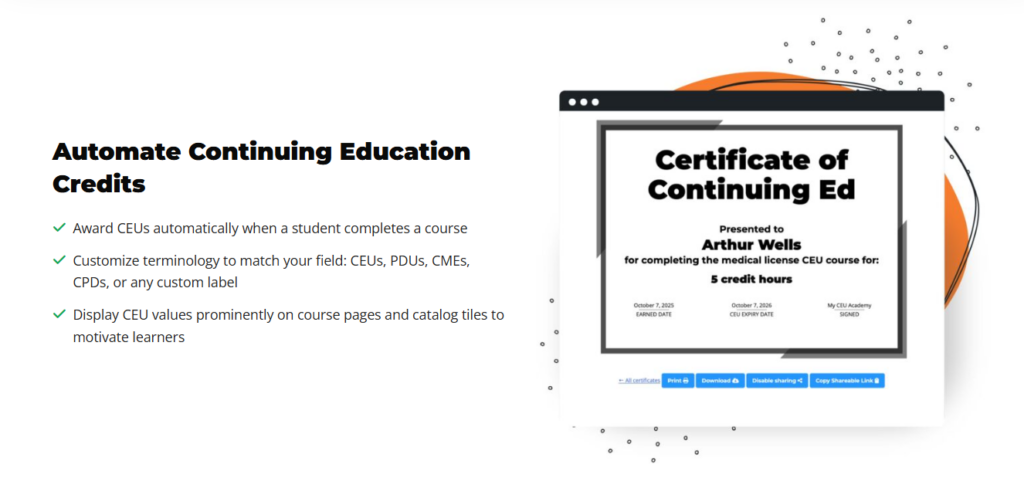
- Certificate generation
- Records and reporting that support accreditation requirements
Generic learning platforms often struggle here, not because they are poorly built, but because they were not designed for professional accountability.
LifterLMS for Continuing Education
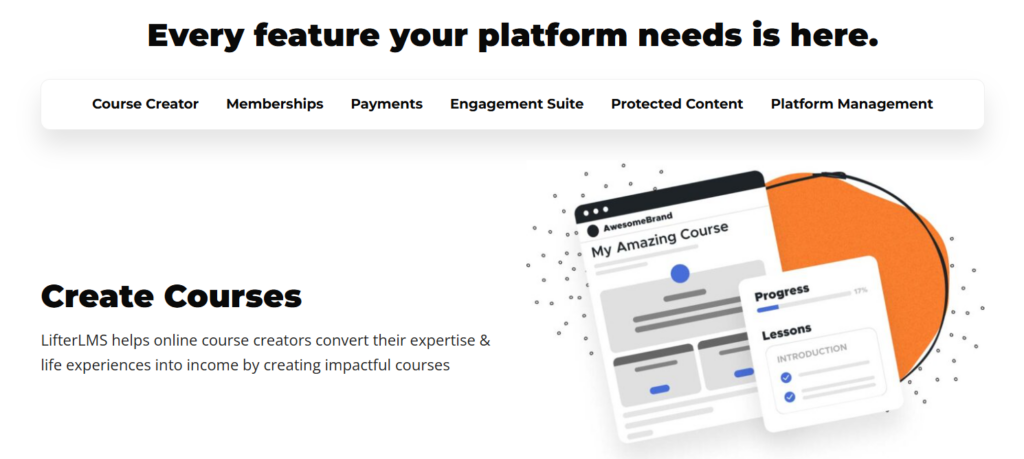
LifterLMS provides the course-building, assessment, progress tracking, certificate, and learner management features needed to deliver professional education through WordPress. Providers can structure their courses around the requirements of their accrediting body rather than being forced into a fixed course format.
The Continuing Education add-on extends this setup by allowing providers to assign and track continuing education credits within LifterLMS. Custom terminology can also be used where an industry refers to credits as CEUs, CPDs, CMEs, or another recognized term.
This combination gives providers control over their courses, learner records, and website while supporting a program that can grow beyond the limits of in-person training.
The Continuing Education add-on is included with the LifterLMS Infinity Bundle.
Closing Thoughts
Continuing education is not simply about checking boxes. It helps professionals maintain their knowledge, keep their credentials active, and continue serving the people who depend on their work.
For providers, it offers a way to share valuable expertise with more people without being restricted by classroom capacity, location, or travel. That opportunity comes with responsibility. Requirements must be clear, credits must be defensible, and records must remain available long after a course has ended.
When those pieces are in place, continuing education supports learners, strengthens professions, and allows trusted training to reach further.
See how the LifterLMS Continuing Education add-on helps providers award and track continuing education credits: