
Group User Roles & Capabilities
The LifterLMS Groups add-on provides four user levels that grant group members permission to perform specific actions within their group.
Since a single LifterLMS user may belong to an unlimited number of groups on a single site, the add-on does not leverage the WordPress roles and capabilities system to provide these user permissions; instead, we use a pseudo role system where the group member.
By working outside of the WordPress role and capability system, you are able to add any WordPress user (with any WordPress role) to any number of groups. If a user belongs to multiple groups, they may have different roles within each group.
manage_group_members: Allows the user to add and remove group members.
manage_group_managers: Allows the user to add, remove, promote, and demote group members, leaders, and administrators.
manage_group_information: Allows the user to modify all of the group’s settings (Name, Web Address Slug, Visibility, Course or Membership) and information (About).
manage_group_seats: Allows the user to increase and decrease the number of seats available to the group. Note: In Phase 1, this capability allows the user to manage seats without any ecommerce transactions; in Phase 2, increasing and decreasing seats will be tied to ecommerce transactions.
view_group_reportingAllows the user to view reporting information for group members.
delete_group: Allows the user to delete the group.
Since these capabilities are pseudo capabilities, not “true” capabilities that are added via the WordPress core capabilities API, you should not add these capabilities to a user directly using WP_Role or WP_User capability addition and removal methods, unless you want the role or user to have the specified capability for every group on the site.
Instead, you should add a user to the group(s) using LLMS_Group_Enrollment methods provided by the add-on.
Primary Administrator: The primary administrator serves as the group’s owner. The Primary Administrator has all the capabilities of an administrator with the added ability to close the group.
Administrator: Group administrators can manage (invite, remove, promote, and demote) all other users in the group except the primary administrator, manage the group’s information and settings, manage the number of seats available to the group, and view group reports.
Leader: Group leaders can manage (invite and remove) group members (not administrators or other leaders), manage the group’s information and settings, except for the Course or Membership associated with the group, and view group reports.
Member: Members are granted access to view the group (if it is a closed group) and are conditionally enrolled into the group’s associated content.
Administrator and LMS Manager: WordPress core site administrators and LifterLMS LMS Managers are automatically provided with the capabilities of a group primary administrator for all groups on the site.
| Role | manage_group_members | manage_group_managers | manage_group_information | manage_group_seats | view_group_reporting | delete_group |
| Group Primary Administrator | ||||||
| Group Administrator | ||||||
| Leader | ||||||
| Member | ||||||
| Site Administrator | ||||||
| LMS Manager |
Note: A group role must also have the WordPress administrator role to upload images to the group page.
Only the primary group administrator can edit the group page.
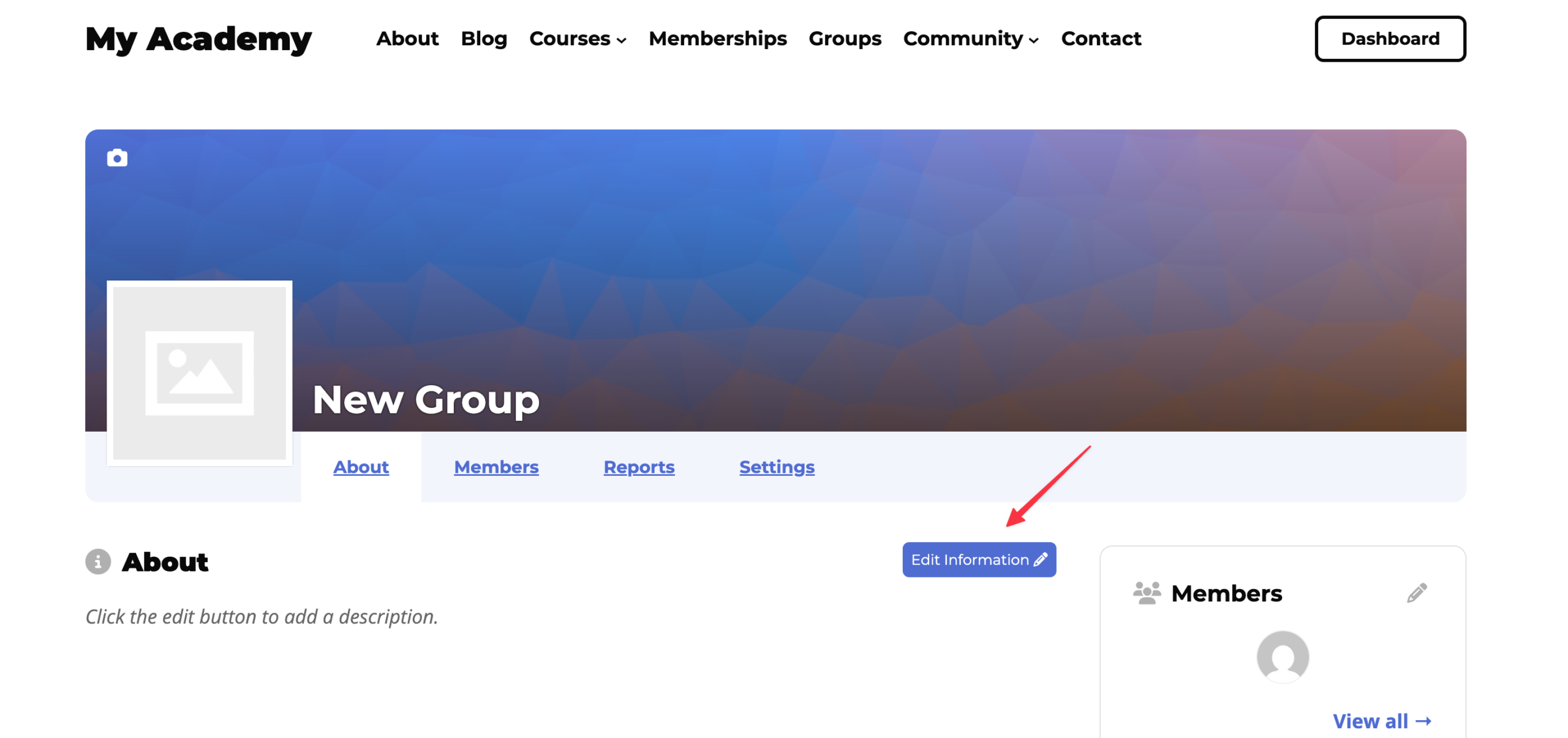
This includes key details such as the group profile picture and the text in the “About” section. Standard group administrators and group leaders do not have access to these settings.
In most cases, editing group details in WordPress requires a higher-level role, such as the LMS Manager role. The primary group administrator is an exception. They can manage the group page even with a student-level account.
To update your group details:
- Go to Groups in your WordPress dashboard
- Click the name of the group you want to edit
- Select Edit Information
- Update the Profile Picture or edit the About section
- Click Save to apply your changes